
NEWS
Trump said he’d accept the midterm results—then pivoted back to election-fraud claims. Here’s what changed, and what it means for the campaign going forward.

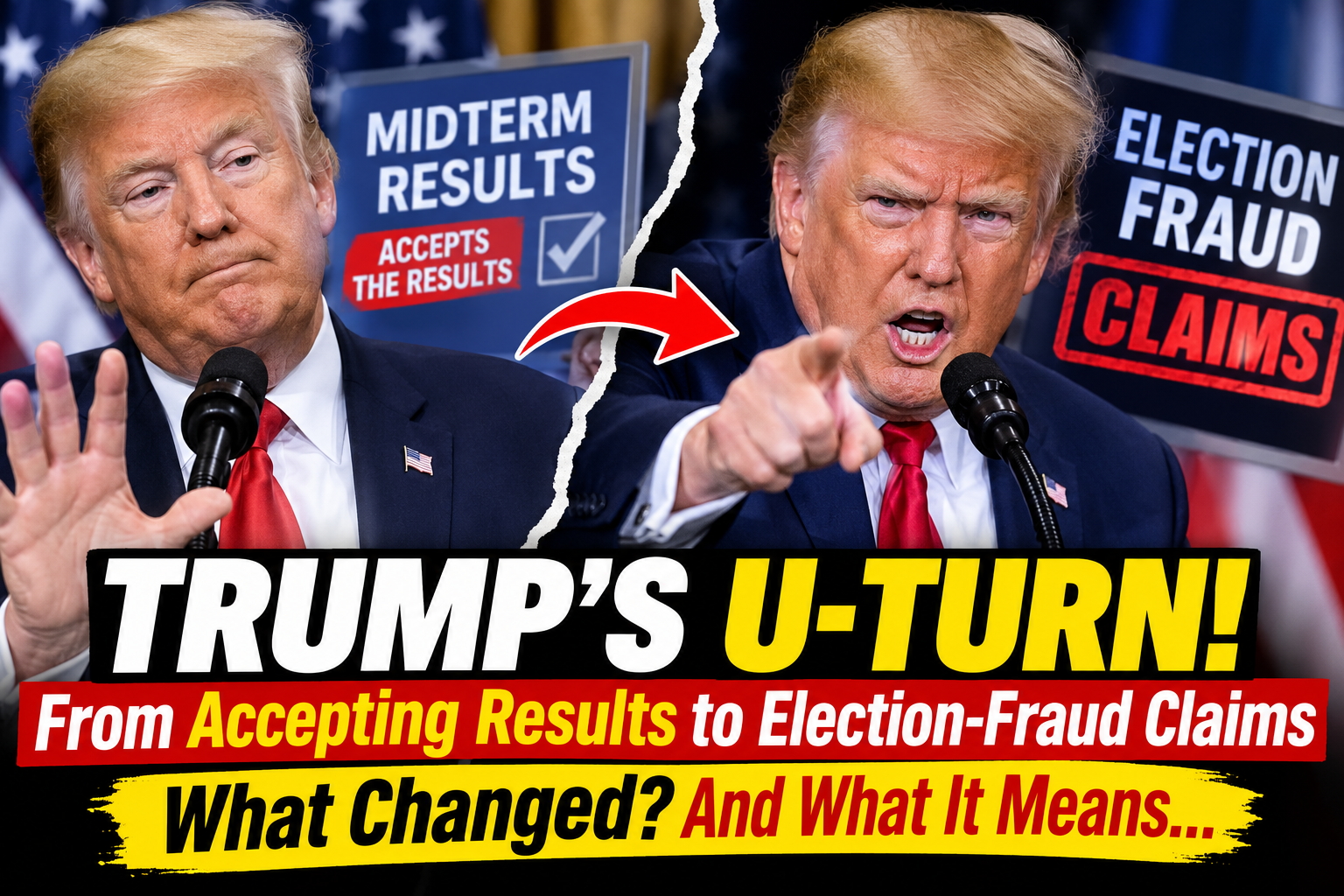
In the days after the most recent U.S. midterm elections, President Donald Trump initially signaled acceptance of the outcome. He publicly acknowledged the results and, in some remarks, suggested he was willing to work with the incoming Democratic leadership. For a brief moment, the messaging looked like it was shifting toward cooperation and standard post-election politics: winners govern, losers regroup, and attention moves to what comes next.
But within a short window, Trump changed course. Instead of staying with the “acceptance” posture, he returned to a familiar theme—questioning whether the election was “honest,” implying that the results didn’t match expectations, and hinting that something must have gone wrong.
That pivot is significant because it doesn’t just affect headlines. It shapes how Trump’s campaign frames legitimacy, how allies and Republican lawmakers position themselves after losses, and how supporters interpret the difference between what they expected and what actually happened at the ballot box.
What Trump said—and what changed
The clearest takeaway is that Trump moved from acknowledging the midterm results to revisiting election-integrity concerns. In his renewed messaging, the core idea is not “we disagree on policy,” but “the outcome itself may not be trustworthy.”
Trump’s claims revolve around the notion that polls and predictions failed to capture the final result. In other words, if the outcome diverged sharply from what many expected, Trump suggests the only logical explanation is that the election process was manipulated—rather than acknowledging the more mundane possibilities: late shifts in voter sentiment, differences in turnout between demographic groups, sampling or polling error, or the inherent difficulty of predicting election outcomes.
Politically, this is a familiar rhetorical move. It keeps the narrative from drifting into post-election accountability—what should the party do differently next time?—and instead turns the conversation toward a legitimacy question: whether voters can trust the system when the results don’t favor Trump or his party.
The “polls were wrong” argument (and why it gets used)
Election messaging often uses a psychological principle: when expectations don’t match reality, people look for an explanation. In this case, Trump’s explanation emphasizes fraud or dishonesty.
But it’s important to distinguish between two different things:
Polls being wrong means the forecasts didn’t predict the outcome accurately.
Fraud being present would mean votes were manipulated or counted improperly in a way that changes results.
Those are not the same. Polling can miss for many reasons. Elections are complex events where late-breaking news, campaign intensity, turnout mechanics, and voter behavior all play roles. Even strong polling models can be wrong—especially in midterms, when turnout dynamics can differ dramatically from presidential elections.
Still, Trump’s framing uses the gap between “what people expected” and “what happened” as a launching point for broader skepticism. It’s a rhetorical bridge that can allow an audience to move quickly from “we were surprised” to “the election can’t be trusted,” even without specific evidence presented publicly.
How critics interpret the shift
Democratic leaders and political critics have generally described Trump’s move as a return to election denialism—an approach that repeatedly challenges legitimacy after outcomes that contradict expectations.
Critics argue that the incentive structure matters. Election skepticism can be emotionally powerful. It provides a ready-made explanation for setbacks that doesn’t require the campaign to fully reassess its strategy. If the election is framed as rigged, then losses aren’t necessarily proof that voters rejected the candidate’s message or policies—they become proof that the system failed.
That can be appealing to a political movement trying to maintain morale after defeat. It also preserves the sense of grievance that helps keep attention focused on conflict with institutions rather than policy adjustments or electoral outreach improvements.
In short, critics see it as not merely a belief, but a political system: a narrative that makes it hard for the campaign to lose momentum after setbacks.
Why the pivot is a challenge for Republicans
Trump’s election-fraud messaging also puts pressure on Republican lawmakers and candidates who may want to move on after midterm results.
When Trump returns to election integrity allegations, other Republicans face a strategic choice:
Echo the narrative** to maintain alignment with Trump’s base,
Distance themselves** to protect credibility with moderates and independent voters, or
Stay quiet**, hoping not to inflame the issue while still maintaining party unity.
Each option comes with tradeoffs. Echoing the claims can energize loyal supporters but can risk reputational harm if specific allegations don’t hold up. Distance can alienate the base. Silence can look evasive or calculated.
This dynamic matters because post-election messaging is not just communication—it’s a signal of who will control the party’s direction going forward: the pragmatists who want institutional stability, or the activists who want to keep the election legitimacy fight central.
What this likely

🚨 WAIT… ARE JENNIFER LOPEZ AND LEONARDO DICAPRIO THE NEW HOLLYWOOD POWER COUPLE? 👀🔥 Their First-Ever Hotel Exit Together Sparks Dating Rumors!

Trump said he’d accept the midterm results—then pivoted back to election-fraud claims. Here’s what changed, and what it means for the campaign going forward.

WHO REALLY CARRIED MEGHAN MARKLE’S CHILDREN? Viral Photos Reignite Surrogacy Speculation — But What Does the Evidence Actually Show?

Jensen Huang, 63, caught on camera in an affectionate and intimate moment with Nvidia vice president of healthcare Kimberly Powell, 48, in another extramarital relationship following recent reports of his cheating with alleged Chinese spy Alice Huang

DID MEGHAN MARKLE JUST REVEAL HOW MUCH HER FAMILY CRISIS IS AFFECTING HER? PRINCE HARRY STEPS FORWARD ALONE IN BRUSSELS!

🚨 NVIDIA IN CHAOS? JENSEN HUANG’S CEO FUTURE HANGS IN THE BALANCE AFTER SHOCKING AFFAIR REPORTS!

Breaking:Caitlin Clark and her boyfriend were spotted enjoying some time together on a yacht. The WNBA superstar is making headlines on and off the court.

So Disgusting: Jennifer Lopez 57 was having the time of her life on the beach, legs spread. With a strange hood looking young man at the Beach

BREAKING: Jeffrey Epstein kept blackmail videos that showed Donald Trump having sex with ‘many girls’ supplied by him, according to the latest bombshell Evidence in newly-unsealed court documents.See it here …..

JUST IN: Democrats Prepare Possible Impeachment Push Against Trump Following Submission of Controversial Epstein Victim Video Evidence……

JUST IN: London Museum Makes a SHOCKING Decision to Remove Russell Brand’s PUBIC HAIR Following His Rape Conviction, as the Curator Says He Never Wants to Hear His Name Again! But How His Bizarre Hair Exhibit Ended Up in the Museum Is Something Nobody Expected!
