
NEWS
🚨 BREAKING: NAVY STANDS FIRM — TRUMP WILL NOT GET HIS NAME ON WARSHIP HONOURING BLACK WAR HERO DORIS MILLER!

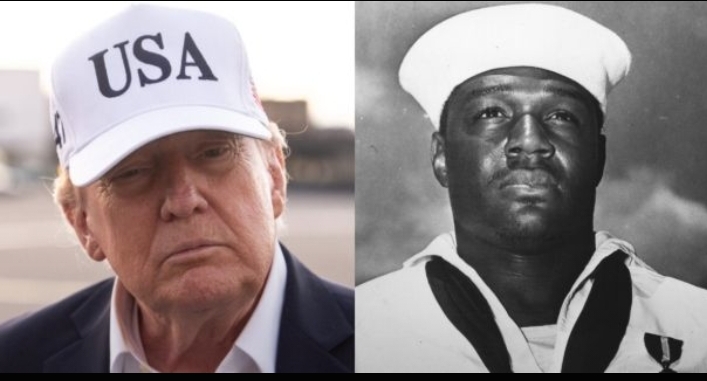
The United States Navy has delivered an important message following weeks of controversy surrounding an aircraft carrier originally scheduled to honour one of America’s most celebrated Black war heroes, Doris “Dorie” Miller.
After reports emerged that military officials had discussed the possibility of renaming the vessel after President Donald Trump, the Navy has now made its position clear: the aircraft carrier will retain the name USS Doris Miller.
The announcement brings a significant development to a story that has attracted political attention, public criticism and renewed discussions about how America remembers the people who sacrificed their lives in military service.
For many Americans, this was never simply a disagreement over the name of a warship. It was about history, recognition, military tradition and whether the extraordinary contributions of a decorated Black sailor should be pushed aside in favour of honouring a sitting president.
HOW THE CONTROVERSY BEGAN
The controversy first gained national attention in August 2026, when CNN reported that Navy officials were considering changing the name of an aircraft carrier under construction.
The vessel had originally been announced as the USS Doris Miller during Trump’s first administration in 2020. However, according to sources familiar with internal discussions, officials had reportedly explored the possibility of giving the carrier a different name, with Trump’s name among the options discussed.
The report immediately generated political reactions.
Doris Miller was not an ordinary sailor. His actions during the Japanese attack on Pearl Harbor in December 1941 made him one of the most recognised American military heroes of the Second World War.
For critics, the possibility of removing his name from an aircraft carrier was difficult to understand, particularly because the ship was intended to recognise his extraordinary courage and sacrifice.
The question quickly became bigger than the Navy itself: should a historic tribute to a war hero be changed to honour a sitting president?
WHO WAS DORIS ‘DORIE’ MILLER?
Doris Miller was born in Texas in 1919 and joined the United States Navy in 1939.
At a time when racial discrimination severely restricted the opportunities available to Black Americans in the military, Miller served as a mess attendant aboard the battleship USS West Virginia.
His life changed forever on December 7, 1941, when Japanese forces attacked Pearl Harbor.
As bombs and gunfire struck American ships, Miller rushed to assist wounded sailors, including his badly injured commanding officer. Despite having no formal training operating anti-aircraft weapons, he eventually took control of a machine gun and fired at attacking Japanese aircraft.
His courage under extraordinary circumstances helped make him a symbol of bravery during one of the darkest moments in American military history.
Miller received the Navy Cross in recognition of his actions, becoming the first African American to receive that prestigious decoration.
His story became an important part of American military history, representing courage in the face of danger and the contributions of Black Americans who served their country despite facing discrimination.
He later died in November 1943 when the aircraft carrier escort vessel USS Liscome Bay was torpedoed during the Second World War.
His sacrifice remains a powerful part of his legacy.
WHY THE AIRCRAFT CARRIER’S NAME MATTERS
The USS Doris Miller was intended to make history for more than one reason.
It would be the first American aircraft carrier named after an enlisted sailor and the first aircraft carrier named in honour of an African American.
That distinction carries enormous significance.
For generations, Black Americans served in the armed forces, defending a country that did not always provide them with equal treatment or opportunities.
Naming a powerful American aircraft carrier after Miller was therefore widely viewed as an important recognition of a man whose courage helped save lives during the attack on Pearl Harbor.
Supporters of keeping his name argued that military honours should recognise service, sacrifice and historical contributions rather than political popularity.
The controversy also revived discussions about the importance of preserving the stories of overlooked military heroes.
THE NAVY FINALLY CLARIFIES ITS POSITION
Now, the latest development appears to have brought the uncertainty to an end.
According to CNN’s November 20 report, a spokesperson for Acting Navy Secretary Hung Cao stated that there was no intention to change the name of the USS Doris Miller.
That statement means the Navy is proceeding with the original naming plan announced in 2020.
The announcement has also been welcomed by members of Miller’s family, who have continued working to ensure his contribution to American history receives the recognition it deserves.
For the family, preserving his name is about more than a military vessel. It is about ensuring that future generations understand the sacrifices made by a man whose bravery became part of the nation’s history.
The family has also continued advocating for Miller to receive the Medal of Honor posthumously, the country’s highest military decoration for valor.
A POLITICAL CONTROVERSY THAT RAISED BIGGER QUESTIONS
The entire episode has exposed how sensitive military naming decisions can become when history and politics collide.
Aircraft carriers are among the most powerful symbols of American military strength. Their names carry historical meaning, national pride and recognition of individuals who have made significant contributions to the country.
Although several American aircraft carriers have been named after former presidents, the reported possibility of naming one after a sitting president attracted considerable attention.
Critics questioned whether changing the name of a ship already designated to honour a decorated war hero would send the wrong message.
Others argued that the original recognition of Miller should remain untouched, regardless of political leadership.
The Navy’s latest statement provides an answer to the immediate question, but the wider debate about military traditions and historical recognition is unlikely to disappear.
WHAT HAPPENS NEXT?
With the Navy indicating that the carrier will retain its original name, attention now turns to the continued construction of the vessel and the efforts to secure further recognition for Doris Miller.
The aircraft carrier is expected to become an important addition to the United States Navy, with delivery anticipated in the 2030s.
For now, the most important outcome is that the name intended to honour a courageous American sailor remains in place.
Doris Miller’s story deserves to be remembered not because of political arguments, but because of what he did when his country needed him most.
And perhaps that is the biggest lesson from this entire controversy: history should never forget the people whose courage helped shape it.

BREAKING: Kate Middleton Finally Breaks Her Silence on the Type and Stage of Cancer She Had Before Undergoing Chemotherapy, Following the Release of the Trailer for Her Cancer Journey Documentary, “Heal”

Jennifer Lopez, 57, Steals the Spotlight During a Relaxing Beach Escape! Fans Can’t Stop Talking About Her Stunning Look and the Surprising Detail Everyone Seems to Have Missed

Footage of President Trump walking out moments ago is getting HUGE attention, and there’s one detail viewers can’t seem to stop noticing. Watch closely

BREAKING: Frail-Looking Joe Biden Suddenly Collapses at Philadelphia Airport While Making His Way Through the Terminal Ahead of Thanksgiving, Leaving Onlookers Stunned! But What Cameras Captured Moments Before He Was Rushed Away on a Stretcher Has Sparked Widespread Concern, With Many Now Asking ONE Disturbing Question About His Health

BREAKING: President Trump almost got arrested at the 2026 APEC Summit for holding President Putin’s hand for too long and had to be cautioned to release it, but moments after letting go, cameras caught him doing something unusual that a president should never be caught doing, right in front of President Xi, while Putin looked visibly frustrated

Heartbreaking News: Just Minutes Ago, Buckingham Palace Releases a Major Tragic Announcement About King Charles, Leaving Queen Camilla, Prince William and Princess Catherine Devastated as the Entire World Are in Disbelief

BREAKING: Donald Trump caught with a strange mould in his mouth at his golf club while watching Fox News, as his aide Natalie Harp slyly adjusts his pants beside him

BREAKING: Pregnant Brittany Mahomes Suddenly Collapses at Arrowhead Stadium During the Chiefs vs. Cardinals Game, Leaving Patrick Mahomes Rushing to Her Side as Fans Watch in Shock, But What Cameras Capture Moments Later Sparks Even More Concern and Has Football Fans Asking Serious Questions About What Really Happened

🚨😱BREAKING: DONALD TRUMP REPORTEDLY COLLAPSES AFTER A TERRIFYING COUGHING EPISODE IN HIS OFFICE FOLLOWING HIS HIGH-PROFILE MEETING WITH CHINA’S PRESIDENT! An Urgent Hospital Rush Sparks Major Speculation, But What Doctors Allegedly Discover Leaves Everyone Waiting for Answers… Only for Doctors to Confirm That He’s…

BREAKING: King Charles Looks Completely Furious, Visibly Screaming at Queen Camilla as They Leave the Royal Albert Hall Following the 2026 Royal Variety Performance! But What Cameras Captured During Their Tense Exchange Has Left Royal Fans Stunned, Raising Serious Questions About What Really Happened Behind Palace Doors.

🚨😱 JUST IN: DONALD TRUMP SPARKS CONTROVERSY After Embarrassing Himself in Diaper-Related Incident During a Private Presidential Suite Encounter With Aide Natalie Harp! But It’s One Unexpected Detail Revealed in Another Camera Angle That Has everyone Talking and some American calls for his immediate resignation
